
Due to the government repeatedly appointing officials to the Truth and Reconciliation Commission (TRC) and the Commission of Investigation on Enforced Disappeared Persons (CIEDP) through political quotas, rather than selecting competent, qualified and impartial individuals, conflict victims have failed to receive justice and reparations even two decades after the peace agreement.
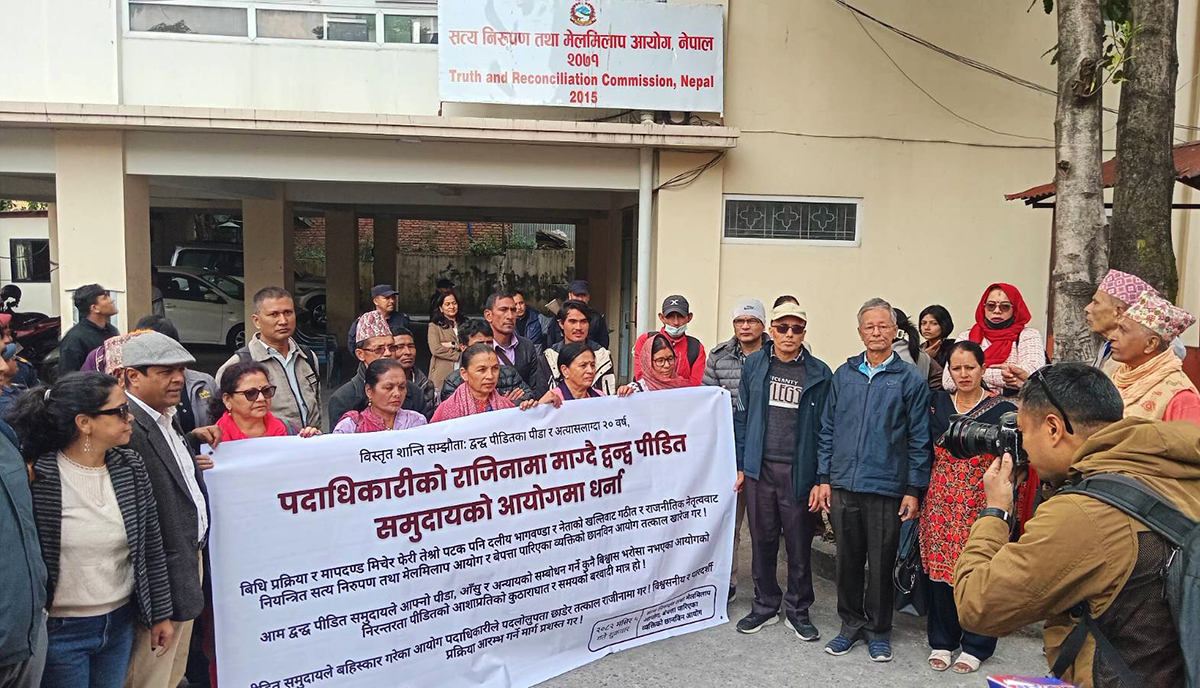
***On November 21, 2025, the day the peace accord entered its 20th year, a strange scene unfolded at the TRC office in Hadigaun, Kathmandu. Conflict victims had gathered before office hours, staging sit-ins and chanting slogans to demand the resignation of commission officials. Seeing the unrest, the officials did not dare enter the office. They watched the victims’ protests from their vehicles and turned back.
 The victims called the Commission’s Secretary, Nirmala Adhikari Bhattarai, to the courtyard to relay their grievances to the leadership. Accompanied by security personnel, she spent an hour standing at the protest site watching the demonstration.
Victims are dissatisfied not only with the TRC, which was formed to provide justice for those affected by the armed Maoist conflict (1996-2006), but also with the CIEDP, tasked with locating citizens disappeared during the war. After protesting at the TRC office on November 21, the demonstrators proceeded to the CIEDP office in Bhadrakali to continue their protest.
Because the government has repeatedly appointed officials to both commissions through political quotas rather than selecting competent, qualified and impartial individuals, conflict victims have remained without justice or reparations even two decades after the peace agreement. Victims state that they are unable to obtain justice precisely because appointments are made by politicizing their long struggle, sacrifices and hardships. This has led to a deep-seated distrust toward the state itself.
Suman Adhikari, son of Muktinath Adhikari, the principal of Panini Sanskrit Secondary School in Lamjung who was killed by Maoists during the armed conflict, explains that the state is insensitive to the victims’ suffering. He asserts that the problem remains unresolved because transitional justice has never been treated as a priority.
The commission officials, who serve four-year terms, were appointed last June for their third tenure. The government first appointed officials on February 11, 2015, and for a second time on January 20, 2020. Under the current system, a recommendation committee is formed to nominate individuals, whom the government then formally appoints to the commission.
However, conflict victims argue that the problem lies in the recommendation committee itself, which they claim is formed through partisan interests and follows party directives. They had already been questioning the competence and credibility of the officials selected by the committee during the second tenure, leading to ongoing boycotts and protests against the commission.
Amidst this, the government formed a five-member recommendation committee on October 18, 2024, led by former Chief Justice of the Supreme Court Om Prakash Mishra, to appoint officials for the third term.
Manoj Dawadi, a member of the National Human Rights Commission who served on that committee, proposed vetting the background, experience and competence of the candidates. However, his proposal was rejected. “I stepped away after the committee faced pressure to simply endorse individuals recommended by top political leadership without evaluating their skills, qualifications or work experience,” he said. “It turns out there are behind-the-scenes maneuvers involved in selecting officials for commissions handling transitional justice.”
Protests continued over the committee’s failure to select qualified, competent individuals and its lack of transparency. When the committee failed to appoint officials within the stipulated two months, it was dissolved. Subsequently, on March 24, 2025, the government formed another recommendation committee, again chaired by Om Prakash Mishra. This marked the third time Mishra had chaired the recommendation committee, having also led the 2020 process.
The Chairperson of the Human Rights Commission, Top Bahadur Magar, appointed member Lily Thapa to the second recommendation committee.
Based on this committee’s recommendations, the government appointed Leela Devi Gadtaula as Chairperson of the Commission of Investigation on Enforced Disappeared Persons (CIEDP), with Gopal Nath Yogi, Agni Prasad Thapalia, Srijana Pokharel and Binita Nepali as members.
Similarly, Mahesh Thapa was appointed Chairperson of the Truth and Reconciliation Commission (TRC), with Achyut Prasad Bhandari, Dr. Tika Prasad Dhakal, Padam Bahadur Shahi and Kumari Kaushalya Ojha as members. Victims allege that Tika Dhakal and Kaushalya Ojha were appointed as party loyalists under the guise of representing the victim community.
Prior to the formation of the recommendation committee, Agni Kharel had been appointed as Human Rights Advisor to Prime Minister KP Sharma Oli. Following this, his interest and involvement in the selection of officials increased significantly. Conflict victims allege that he hijacked the entire recommendation committee process to select officials based on partisan power-sharing, using the committee merely to rubber-stamp the choices.
However, Agni Kharel flatly denies these allegations. “I have not engaged in any ‘setting’ or interference regarding the selection of commission officials,” he stated. “The recommendation committee selected the current officials through the formal process itself.”
Conflict victims allege that the committee failed to engage in sufficient discussion or debate with them regarding the recommendation of officials. In April 2025, victims drew attention to the need for selecting competent, qualified and impartial individuals who are trusted by society and represent the victim community, through a credible, transparent process involving public hearings and established criteria. They also met with the UN Resident Coordinator, Hanna Singer-Hamdy, demanding that the transitional justice process be consultative, inclusive and victim-centered.
However, without conducting public hearings or adopting transparent criteria, the committee published a recommendation list on April 26, 2025, featuring names brought in through political quotas. Immediately following the release of the list, victims staged a sit-in at the Human Rights Commission to protest. Demanding that the names be corrected, victims held discussions with the Prime Minister and top leaders of the three major parties. Although the committee had scheduled a timeframe to consult with victims regarding the list, no such discussion took place. On May 21, 2025, the Cabinet meeting formally decided to appoint the individuals recommended by the committee.
Surya Dhungel, a former member of the Human Rights Commission, states that everyone appointed to both commissions came through party recommendations and that the committee failed to follow its own standards. Surya Kiran Gurung, former Chairperson of the Truth and Reconciliation Commission, adds that the committee is merely fulfilling a formality by endorsing whomever the party leaders recommend. He states, “The orders come from the top. That is where the manipulation happens. The committee’s loyalty clearly lies with the political parties.”
Former Chairperson Surya Kiran Gurung stated that the trend of everyone from the Chairperson to the members being appointed through party quotas and subsequently acting to defend their respective parties existed in the past and continues today. “There is a situation where members appointed by a party immediately move to protect their party’s interests as soon as its cases arise. Such maneuvering occurred among members in the past as well,” he said.
Members of the most recent recommendation committee had argued that the law did not allow for the inclusion of victim representatives and that doing so would create a conflict of interest. However, Dr. Tika Dhakal and Kaushalya Ojha were ultimately appointed through political quotas under the guise of being victim representatives. Dhakal himself maintains that he joined the commission on behalf of the victims.
“While victims raise the issue of conflict of interest, they haven’t specified whose interest is at play,” he said. “Their claims cannot be substantiated. These are things being said just for the sake of saying them.”
Conflict victims have continued their struggle even after the appointment of the officials. Last August, victims filed a writ petition in the Supreme Court regarding the qualifications, proficiency, competence and selection criteria of the current commission officials.
They also appealed to President Ram Chandra Poudel to take appropriate initiatives, stating they had been subjected to betrayal, insult and injustice. Furthermore, expressing their disagreement with the committee’s activities and performance, victims met with Sher Bahadur Deuba, Pushpa Kamal Dahal ‘Prachanda’, and then-Prime Minister KP Sharma Oli.
“The recommendation committee only followed the bare legal formalities. They did nothing to ensure transparency, conduct public hearings or seek the opinions of victims,” said Surya Dhungel, a former member of the Human Rights Commission. “Instead, they focused on facilitating political and partisan power-sharing.”
The leadership of the Human Rights Commission itself faces allegations of operating along political lines rather than addressing the victims’ demands. Although the Commission issued a statement on May 22, 2025, urging for work to be done by taking victims into confidence, the victims dismissed it as merely a calculated attempt to gain their sympathy.
“The commissions created for victims have instead been filled with the relatives and cadres of political leaders and influential power brokers. The officials were selected through a partisan syndicate,” said conflict victim Suman Adhikari. “That is why there is such deep distrust toward the commissions. It hurts to see the state mocking the pain of the victims.”
According to the victims, Agni Kharel, the then-Prime Minister’s Human Rights Advisor, and newly appointed member Dr. Tika Dhakal have influenced certain poor, marginalized and uneducated victims by promising long-term relief and reparations, such as jobs and scholarships.
“The allegations that we engaged in political maneuvering or enticed victims are being spread just for the sake of saying them. They cannot be proven,” said Commission member Dr. Tika Dhakal.
UML leader Agni Kharel also maintains that there were no attempts to influence victims through economic inducements such as scholarships, employment or similar offers.
Srijana Pokharel, who was appointed as a member of the Commission of Investigation on Enforced Disappeared Persons (CIEDP), is the wife of human rights activist Gopal Krishna Siwakoti. Victims allege that Gopal Krishna influenced then-Prime Minister KP Oli, as well as Prachanda and Agni Kharel, to secure her appointment.
However, Gopal Krishna is not ready to accept that allegation.
“I did not lobby or associate with PM Oli and other leaders to place my wife in the commission. It was the victims themselves who brought forward these names,” he said. “Some victims even submitted my wife’s name in writing and she came through a competitive process.”
However, although the names of 35 individuals, including Srijana, were initially sent to the recommendation committee with support, the victims later withdrew her name along with others. Srijana herself claims that she was selected through open competition based on her qualifications from foreign universities and her professional experience. She stated, “Claiming that I took this position through my husband’s reach and influence is merely propaganda spread by those who didn’t get the roles themselves. I will prove myself to them by demonstrating my competence and long-standing expertise through my work at the Commission.”
Lokendra Mallick, former Chairperson of the Commission of Investigation on Enforced Disappeared Persons (CIEDP), states that the government made appointments based on political power-sharing in the past, and that same ‘disease’ has resurfaced now. “Victims should have been included in the Commission but that did not happen,” he said.
In its own 2023/24 report, issued while the commission was without officials, the CIEDP had urged the government to appoint competent officials capable of working independently, impartially, neutrally and credibly. However, the government ignored even the Commission’s own report recommendations and appointed officials through political quotas.
Section 5.2.5 of the Comprehensive Peace Accord (CPA) stipulates the formation of a high-level Truth and Reconciliation Commission to investigate the truth regarding those involved in gross violations of human rights and crimes against humanity during the armed conflict, and to create an atmosphere of reconciliation in society.
Article 33 of the Interim Constitution of Nepal (2007) stipulates the provision of relief to the families of victims based on the reports of the commission formed to investigate those disappeared during the armed conflict. It also mandates the formation of a high-level Truth and Reconciliation Commission to investigate the truth regarding individuals involved in gross violations of human rights and crimes against humanity, bring perpetrators to justice, create an atmosphere of reconciliation in society, and arrange for relief and reparations for victims.
The Peace Accord included commitments to make public the status of citizens killed or disappeared by the conflicting parties within two months, and to establish the Truth and Reconciliation Commission within six months to ensure truth, justice and reparations.
However, even 20 years after the Peace Accord, this work remains incomplete. The government established the Truth and Reconciliation Commission (TRC) and the Commission of Investigation on Enforced Disappeared Persons (CIEDP) only nine years after the peace agreement was signed. According to the Enforced Disappearances Enquiry, Truth and Reconciliation Commission Act (2014), the TRC is responsible for investigating incidents of human rights violations and gross violations of human rights, uncovering the truth, maintaining records and bringing the actual facts to light.
The Commission is also tasked with analyzing the trends, nature and severity of human rights violations and gross violations of human rights, as well as the actions taken by the parties to the armed conflict.
It holds the authority to identify the underlying causes of the armed conflict and recommend policy, legal and structural reforms to ensure that gross violations of human rights do not occur in the future. Furthermore, it is empowered to recommend individuals involved in gross violations of human rights for vetting. Similarly, the Act mandates the Commission of Investigation on Enforced Disappeared Persons (CIEDP) to establish the truth, identify the disappeared and recommend punishment for perpetrators and reparations for victims.
Even governments led by the former warring parties failed to act
The Comprehensive Peace Accord (CPA) identified state restructuring, the management of Maoist guerrillas, and addressing the gross human rights violations committed during the violent conflict as its core mandates.
In accordance with this, the integration of Maoist guerrillas into the Nepal Army was completed, and a new constitution was drafted to fulfill the responsibility of restructuring the state.
However, victims of the gross human rights violations from that era have yet to receive justice. The progress of transitional justice has not moved an inch in over a decade. This remains the case even though the CPN (Maoist), a former party to the conflict, has joined the government multiple times since the peace agreement. Pushpa Kamal Dahal ‘Prachanda’, a signatory to the peace accord himself, has served as Prime Minister three times.
A commission indifferent to victims
Devi Khadka of the Conflict Victim Women National Network (CVWN), along with others, sought a six-point commitment from the Commission regarding safety, sensitivity and confidentiality before survivors of sexual violence would submit their complaints. However, the Commission rejected their proposal. Consequently, the victims kept their full accounts to themselves and only registered a notification of information with the Commission. Victims state that they did not fully participate in the complaint process because they lacked trust in the Commission’s ability to maintain confidentiality and handle their cases with sensitivity.
Conflict victim Devi Khadka explains that the long struggle for truth and justice has made even basic survival in society difficult. “Those who died are gone but how much longer must the living endure pain, injustice and insult?” she asks. “The government’s delay in identifying the truth and delivering justice has made us victims of the state itself.”
According to Dr. Ganesh Datta Bhatta, former Chairperson of the Truth and Reconciliation Commission, the complaints filed with the Commission include incidents beyond imagination. “When we conducted a preliminary study of 2,500 to 3,000 complaints, we found the incidents to be extremely grave and painful,” he said. “We found matters in the complaints that we had never even imagined.”
Surya Kiran Gurung, former Chairperson of the Truth and Reconciliation Commission, noted that 63,000 complaints were archived during his tenure, though even the process of collecting those complaints was fraught with difficulty. “Even as complaints were being filed, perpetrators would go to the victims to threaten them or try to lure them with inducements,” he said.
The objectives of transitional justice are to prevent human rights abuses, investigate past crimes, identify and punish human rights violators, provide victims with proper justice and reparations, and ensure such crimes do not recur in the future.
Its ultimate goal is to establish sustainable peace and foster an environment of social reconciliation between individual victims and perpetrators. However, victims complain that the Commission failed to create an environment conducive to even filing complaints. Human rights activists are increasingly concerned that this will lead to a loss of evidence and the eventual closure of all legal paths to justice. “The state’s policy of trying to exhaust, break and intimidate us has created despair but we will not grow weary or give up our demand for justice under any circumstances,” said conflict victim Gita Rasaili.
The Commission also faces allegations that it failed to consult victims when drafting laws and regulations. Victim Surendra KC stated that neither the Commission nor the Ministry engaged in sufficient discussion when drafting the Commission’s internal regulations for the Ministry of Law, or when finalizing the Reparations Fund Operation Regulations passed by the Cabinet last October.
Nirmala, the Secretary of the Truth and Reconciliation Commission, states that they invite victims for interactions whenever necessary but claims that some victims simply do not show up.
Similarly, Commission member Tika Dhakal asserts that the Commission has conducted interaction programs in several districts and did not discriminate against any victims during those events. “Although we invited all victims, some have chosen not to attend the Commission’s programs,” he said.
New cases overshadow old ones
Former Chief Justice Anup Raj Sharma states that conflict victims are becoming increasingly isolated as the commissions, civil society and even the media are no longer standing by them. He believes the state itself is acting in bad faith toward the victims. “Why did the deaths occur? Why did people disappear? Who was responsible? Keeping these facts hidden is a betrayal and a matter of shame for the state,” he says. “Justice delayed is justice denied.”
Manoj Duwadi, a member of the Human Rights Commission, also notes that the state’s irresponsibility and dishonesty have caused the victims’ voices to fade, pushing their struggle and the entire issue into the shadows. Conflict victims feel that impunity is rising in society because perpetrators have not been brought to justice. Victim Pratik Karki mentions, “Society remains restless because the wounds of the past war have not healed and justice has not been served.”
As time passes, new issues emerge, causing previous ones to be overshadowed. “Investigating past conflict incidents and delivering justice to victims is no longer even a priority for the state,” he said.
Dr. Ganesh Datta Bhatta, former Chairperson of the Truth and Reconciliation Commission, says it is a tragedy that the Commission has failed to function for a decade, making judicial resolution and justice for victims increasingly complex. He expressed doubt that the current Commission or its officials will achieve anything now, given that the state has shown no commitment to acting responsibly.
Conflict victim Suman Adhikari laments that despite fighting for justice on the streets for 26 years with his complaint in his bag, he remains empty-handed. He stated that even if the state tries to exhaust and break them, they will not back down from their fight for justice.
Deceiving the international community
The government has consistently pledged to conclude the transitional justice process as swiftly as possible. In the Universal Periodic Review (UPR), a special mechanism of the United Nations Human Rights Council, the government maintains every year that it is finalizing transitional justice.
In its UPR reports, the Government of Nepal committed to concluding the peace process in accordance with the victims’ demands, international practices and the orders and verdicts of the Supreme Court.
Murari Kharel, Secretary of the National Human Rights Commission, stated that alongside the government’s periodic review report, the Commission submitted its own report suggesting that transitional justice and legislation must center on justice for the victims and that state mechanisms must operate credibly.
As a member state of the United Nations, Nepal has ratified international human rights and humanitarian laws. Therefore, the failure to provide justice to victims and punishment to perpetrators of conflict-era crimes invites international scrutiny. Former Chairperson Surya Kiran Gurung notes that, for this reason, four political leaders cannot simply settle this matter according to their own convenience.
If the state fails to provide justice, reparations and compensation, political parties may face future complications due to the principle of international jurisdiction regarding human rights violations.
Please adhere to our republishing policy if you'd like to republish this story. You can find the guidelines here.
Comments